
04/11/2026 - Press release
The Cancer Immunotherapy Research Group, a joint research group of the Hospital del Mar Research Institute (HMRIB), the Spanish National Cancer Research Centre (CNIO) and the Hospital 12 de Octubre Research Institute (i+12), has published a significant study in Advanced Science that could pave the way towards overcoming one of the main challenges associated with antitumour therapies using genetically modified T cells, known as CAR-T or STAb-T therapies: the high levels of toxicity they can cause in patients. The study, featured on the journal's cover, has demonstrated that the activity of these cancer treatments can be activated and regulated through the administration of a drug. Furthermore, the approach has proven effective against both haematological malignancies and solid tumours. This is the first time such an effect has been achieved in the field of STAb-T therapies.
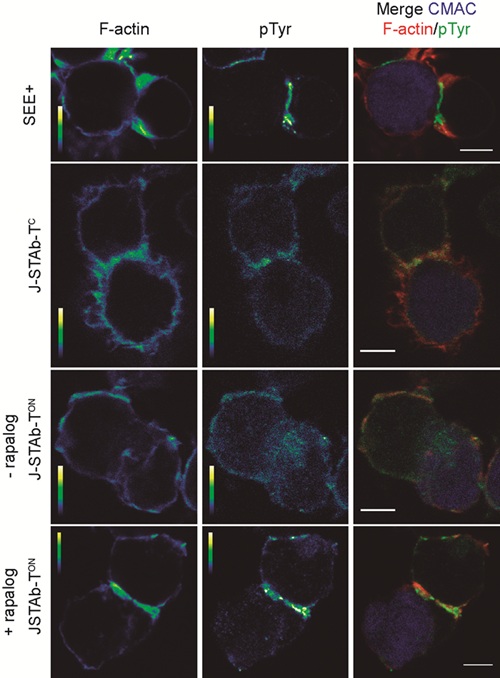
Pharmacologically regulated immunological synapse formation
The researchers, co-led by Dr Luis Álvarez-Vallina, coordinator of the group and Scientific Director of the Banc de Sang i Teixits de Catalunya, and Dr Anaïs Jiménez-Reinoso, from the i+12 Research Institute and CNIO-HMRIB, have developed an antitumour cell therapy platform based on STAb-T therapy, also known as STAb-T cell therapy. This approach uses the patient's own T cells, which are genetically modified. Unlike CAR-T therapies, this modification not only enables the cells to attack cancer cells directly but also allows them to continuously secrete bispecific antibodies that activate the immune system. The challenge with these treatments is that the antigens they target are not exclusively present on tumour cells but are also expressed, albeit at lower levels, in healthy tissues. As a result, the modified T cells may also attack healthy tissues, causing severe toxicity and, in some cases, potentially putting the patient's life at risk.
Switching them on when needed
The researchers have developed a new cell therapy that "opens the door to using pharmacological regulatory systems to control the activity of antitumour cell therapies," explains Dr Álvarez-Vallina. To achieve this, they designed a modular structure consisting of two antibody modules in the modified T cells. One module is designed to recognise the target expressed on tumour cells, while the second recognises T cells. The innovative aspect of this approach is that the immune response is only activated in the presence of a specific drug that enables the two modules to interact.

Dr. Luis Álvarez Vallina
In this way, "the drug acts as a chemical switch. The two antibody modules do not assemble and the modified T cells are not activated unless the drug is present to trigger the reaction, thereby initiating the immune response against the tumour," explains Susana Luengo-Arias, a researcher at the i+12 Research Institute and CNIO-HMRIB and first author of the study.
Dr Jiménez-Reinoso adds that "this ability to regulate the response is particularly relevant for solid tumours, as many of their therapeutic targets are also found in healthy tissues." The new therapy has been tested in in vitro models and in mice, using both haematological tumour models targeting the CD19 protein and solid tumour models targeting the EGFR protein. "In addition to demonstrating that the modified T cells were only activated in the presence of the drug, we confirmed that their activity could be regulated by adjusting the dose and even stopped when necessary," explains Dr Jiménez-Reinoso.
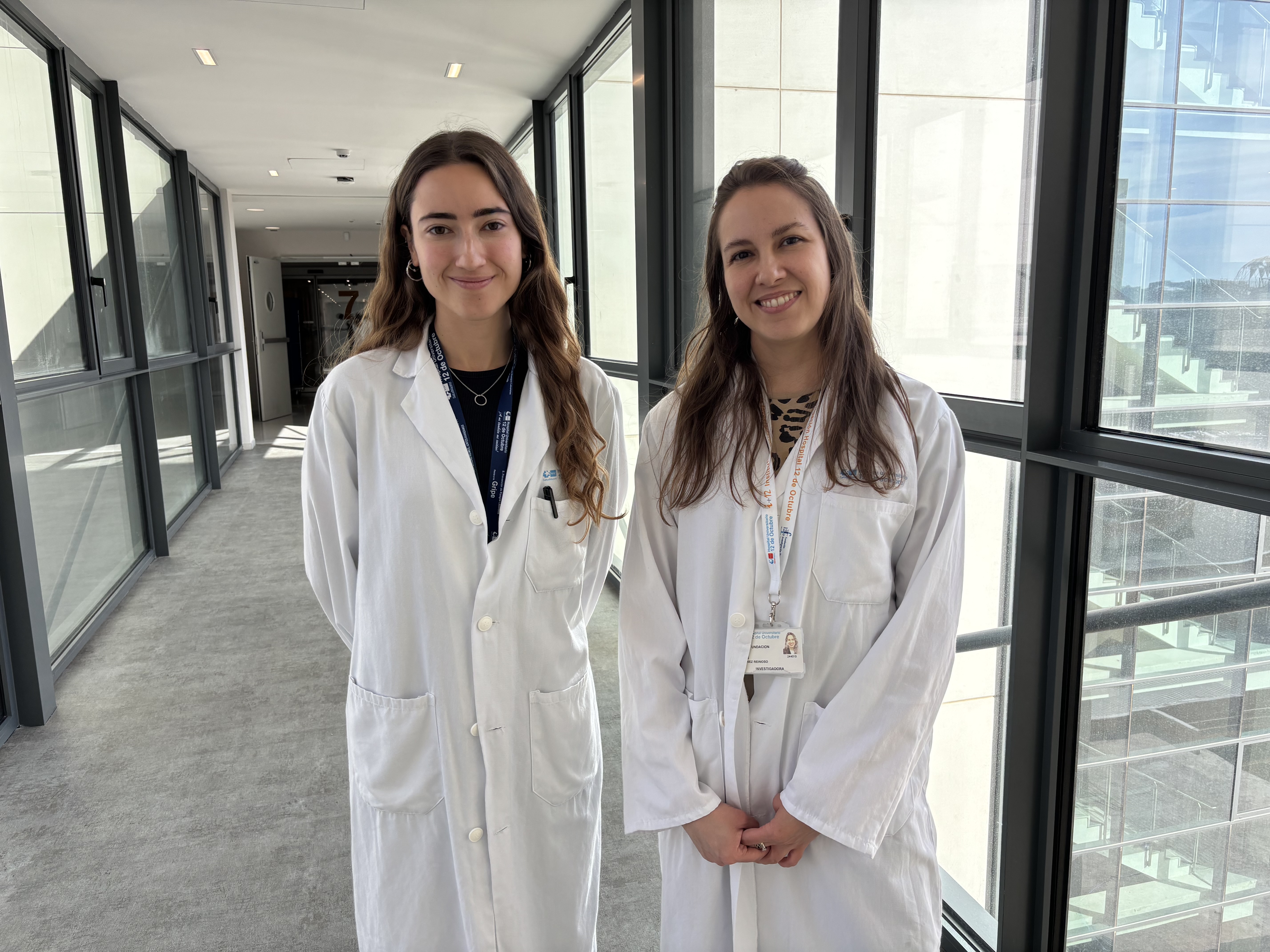
From left to right: Susana Luengo, Dr. Anaïs Jiménez Reinoso
"Having pharmacological control would make it possible to adjust the intensity and duration of the modified T-cell response, as well as reduce or interrupt therapeutic activity if adverse effects were detected," says Dr Álvarez-Vallina. Furthermore, because the system has a modular structure, it can be adapted to different therapeutic targets to treat various types of solid tumours. Although its clinical usefulness will need to be confirmed through further safety studies and clinical trials involving patients, this approach opens the door to safer and more adaptable cellular immunotherapies.
Reference article
Luengo-Arias S, Domínguez-Alonso C, Zagorac I, Tapia-Galisteo A, García-Veros E, Rubio-Pérez L, Gómez-Rosel M, Fuentes P, Hernández-López P, Aguilar-Sopeña Ó, Almagro-Puente L, Martínez-González S, Cañizares-Moscato L, Rivas-Sánchez M, Blanco B, Ramírez-Fernández Á, Díez-Alonso L, Blanco-Aparicio C, Arroyo-Ródenas J, Martínez-Torrecuadrada J, Toribio ML, Roda-Navarro P, Jiménez-Reinoso A, Álvarez-Vallina L. A Drug-Gated, Modular STAb-T Immunotherapy With External Control. Adv Sci (Weinh). 2026 Aug 24. doi: 10.1002/advs.77236. Epub ahead of print. PMID: 42635975; PMCID: PMC13502364.
Servei de Comunicació:
Marta Calsina(ELIMINAR)
Tel:
(+34) 93 316 06 80
Doctor Aiguader, 88
08226 Barcelona
© Institut Hospital del Mar
d'Investigacions MèdiquesLegal Notice and Privacy Policy | Cookie Policy | Site Index | Accessibility | Find Us | Contact
