
08/05/2026 - Press release
A new study led by the Hospital del Mar Research Institute (HMRIB) reveals the potential involvement of immunoglobulin D (IgD), antibodies of the immune system that have so far been little studied, in the mechanism that triggers allergies. The work highlights the importance, until now overlooked, of this type of immunoglobulin within the immune system, and identifies both the location and the cells from which it originates. The results of the study, which involved researchers from research centers in Germany, Austria, Spain, the United States, Italy, Norway, and the United Kingdom, as well as from the CIBER areas for Respiratory Diseases and Infectious Diseases (CIBERES and CIBERINFEC), have been published in the Journal of Experimental Medicine.
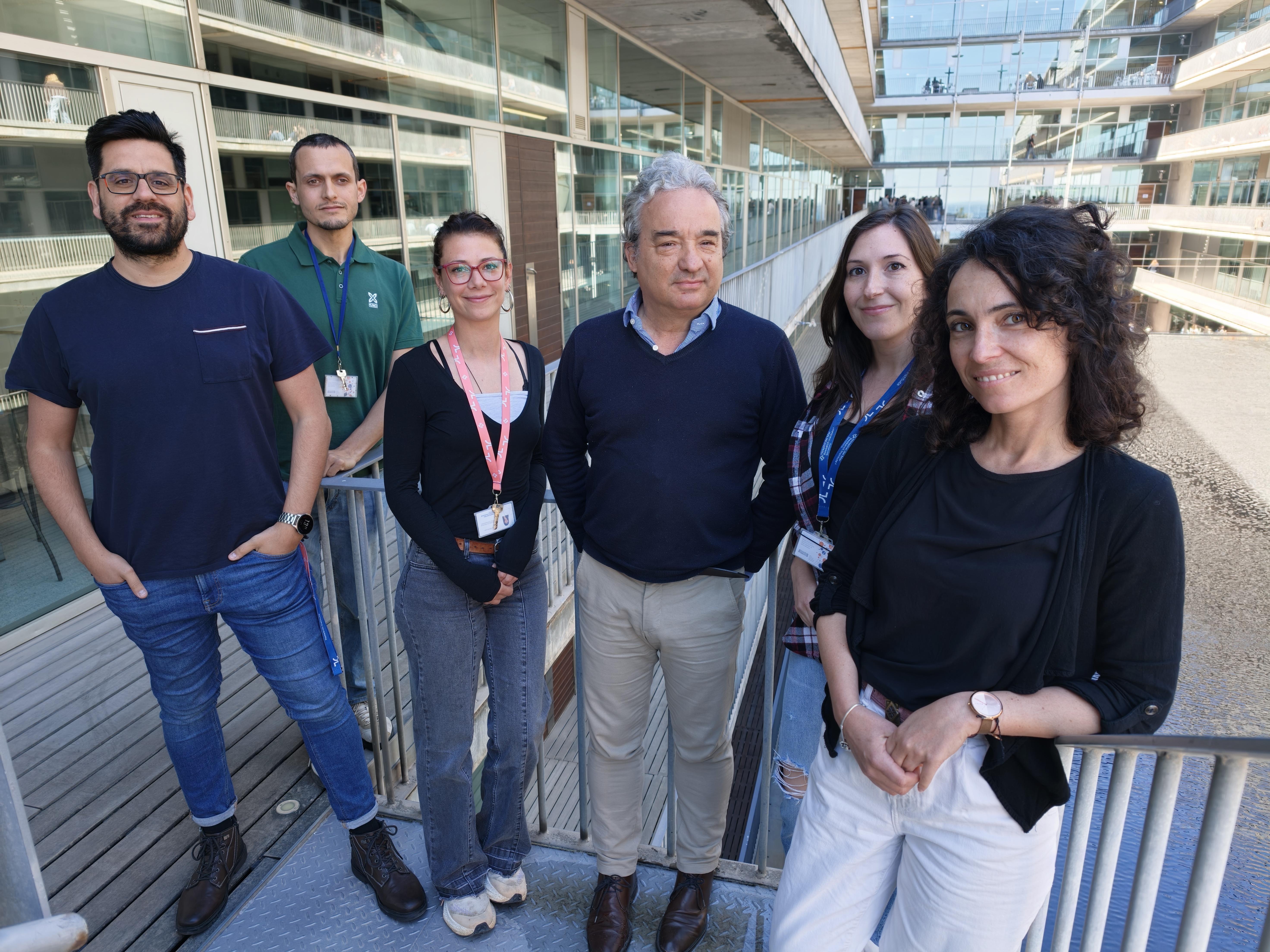
From left to right: Mauricio Guzman, Xavi Marcos Fa, Donata Martinuzzi, Andrea Cerutti, Celia Corral Vazquez and Martyna Filipska
The researchers were able to confirm that memory B cells (a type of B lymphocyte generated after a first exposure to a pathogen in order to remember it), specifically IgD memory cells, are the ones that differentiate into plasma cells, which are the cells that produce immunoglobulin D. They also determined, with a level of detail and characterization not achieved until now, their location in the tonsils. Until now, their presence had been detected in the blood, but where they originated had not been studied. Their function is to secrete IgD, together with other immunoglobulins, which are located in the nasopharyngeal mucosa to recognize commensal, food, and environmental antigens, thus contributing to the balance, or homeostasis, of the mucosa.
This location is important because it represents "the body's first contact with antigens, through the airways or food", explains Andrea Cerutti, coordinator of the B Cell Biology Research Group at HMRIB and an ICREA researcher. At the same time, he highlights "its importance in the development of tolerance to environmental antigens, including allergens", and points out that "we believe that the role of IgD is relevant to the development of this tolerance. If it fails, allergies may appear". In addition, its levels tend to be higher in the first years of life, when this tolerance is generated. It is therefore a key component in the process that may lead to the appearance of allergies.
The study also confirms complex regulatory mechanisms of IgD by analysing patients with various types of primary immunodeficiencies. In these patients, when key signals involved in cell regulation (BCR, CD40, TACI, TLRs) fail, IgD disappears. On the other hand, when regulatory pathways are altered, it accumulates in excess.
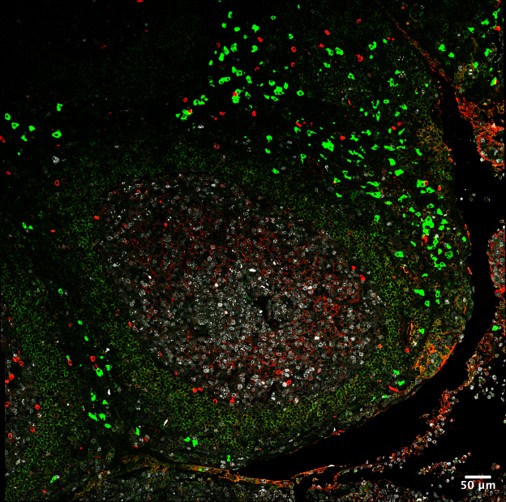
Section of tonsil tissue. IgD in green and IgM in red.
Possible treatment for allergies
The data obtained in the study "highlight the possibility that the immunoglobulin D response contributes to the balance of the nasopharyngeal mucosa, including tolerance to common antigens", says Celia Corral-Vázquez, researcher at the Hospital del Mar Research Institute. If this is the case, "therapeutic strategies focused on IgD may reduce inflammatory problems, including allergy", she adds.
"If it is demonstrated that immunoglobulin D generates an anti-inflammatory response and counteracts the effects of the allergic reaction, this would be the first step toward developing drugs based on it, as a tool that could trigger an anti-inflammatory response and help desensitize allergic patients", explains Martyna Filipska, also a researcher at HMRIB and co-author of the study.
The HMRIB team is already preparing new studies to analyse this treatment pathway, which also has potential in other pathologies. The possibility of using IgD as a treatment or vaccine for allergic reactivity in mice will be analysed in in vivo models.
Reference article
Roser Tachó-Piñot, Habib Bashour, Martyna Filipska, Celia Corral-Vazquez, Mauricio Guzman, Xavi Marcos-Fa, Donata Martinuzzi, Hannah Honner, Pablo Canales Herrerias, Sonia Tejedor Vaquero, Alba Sáez Gordón, Julia Perera-Bel, Jorge Domínguez Barragán, Berta Arcos-Ribas, Leire de Campos-Mata, Andrei Slabodkin, Maria Chernigovskaya, Maria Luisa Rodríguez de la Concepción, Jose Gutierrez-Marcos, Ana García-García, Andres Nascimento Osorio, Mariona Pascal, Jordi Yagüe, Manel Juan, Juan Ignacio Aróstegui, Rafael Hijano Esqué, Albert Sánchez Font, Stephan Ehl, Bodo Grimbacher, Marta Rizzi, Laura Dotta, Kang Chen, Raffaele Badolato, Laia Alsina, Saurabh Mehandru, Charlotte Cunningham-Rundles, Jorge Carrillo, Giuliana Magri, Victor Greiff, Andrea Cerutti; IgD from atypical-like memory B cells and plasma cells targets commensal and environmental antigens. J Exp Med 4 May 2026; 223 (5): e20251752. doi:https://doi.org/10.1084/jem.20251752
Servei de Comunicació:
Marta Calsina(ELIMINAR)
Tel:
(+34) 93 316 06 80
Doctor Aiguader, 88
08226 Barcelona
© Institut Hospital del Mar
d'Investigacions MèdiquesLegal Notice and Privacy Policy | Cookie Policy | Site Index | Accessibility | Find Us | Contact